Emotions are an integral part of our human experience, yet we all process them uniquely. Some of us bottle them up, while others brood over them. Understanding how we manage our emotions is crucial for our mental well-being. Today, we dive into two common emotional styles: bottling and brooding, and how to navigate them effectively.
The Bottler: Keeping Emotions Locked Away
Bottlers often suppress their feelings, viewing emotional expression as a vulnerability. They might avoid emotional conversations, dismiss their own emotions, and even experience physical symptoms like headaches due to unprocessed feelings. This emotional style can lead to difficulties in forming deep connections with others and may manifest in passive-aggressive behavior.
The Brooder: Dwelling on Emotions
Brooders, on the other hand, tend to replay their emotions and situations in their minds, often leading to a cycle of overthinking and anxiety. This constant rumination can hinder problem-solving abilities and contribute to negative self-talk, increased anxiety, depression, and sleep disturbances.
Identifying Your Emotional Style
Recognising whether you’re a bottler or a brooder is the first step towards managing your emotions effectively. Ask yourself:
Do I avoid expressing my emotions?
Do I replay negative events in my mind?
Do I struggle with anxiety or holding grudges?
Acknowledging your tendencies can help you adopt healthier coping strategies.
Strategies for Emotional Management
For Bottlers:
Practice Emotional Expression: Start by sharing your feelings with someone you trust.
Journaling: Write down your thoughts to help process them.
Mindfulness: Observe your emotions without judgment. Accept them and let them pass.
Professional Help: Seek guidance from a professional for healthier coping mechanisms.
For Brooders:
Challenge Negative Thoughts: Reframe negative thoughts with realistic perspectives.
Set Rumination Limits: Allocate specific times for reflection, then shift focus.
Practice Self-Compassion: Be kind to yourself, especially during tough times.
Understanding your emotional style and implementing these strategies can lead to better emotional health, improved relationships, and reduced stress. Take the time to explore your emotional landscape and empower yourself to navigate your feelings with intention and awareness.
In our fast-paced world, where productivity and efficiency often take center stage, it can feel indulgent to dedicate time to imagination and creativity. Yet, making space for a creative imagination is not just a luxury; it’s an essential ingredient for personal growth, problem-solving, and overall well-being. From sparking innovation to fostering mental health, the benefits of nurturing creativity extend far beyond the artistic realm. Here’s why creating room for your imagination can positively transform your life.
1. Boosts Problem-Solving Skills
Creative imagination enables you to think beyond conventional solutions and approach challenges with a fresh perspective. Whether it’s a work-related issue or a personal dilemma, imaginative thinking encourages you to explore “what if” scenarios, uncover hidden opportunities, and devise innovative solutions. For example, many groundbreaking inventions—from the lightbulb to the smartphone—stemmed from someone’s ability to imagine possibilities that didn’t yet exist.
Takeaway: A creative mind is more adaptable and equipped to navigate life’s complexities.
2. Enhances Emotional Resilience
Engaging in imaginative activities—like painting, writing, or daydreaming—acts as a safe space to process emotions and explore alternative perspectives. It can help you work through stress, anxiety, or sadness by providing a mental escape or by framing challenges in a new light. Moreover, imagination allows you to envision positive outcomes, fostering hope and resilience even in difficult times.
Takeaway: Creativity is a natural outlet for emotional expression and healing.
3. Fuels Innovation and Success
History is rich with examples of creativity driving success in unexpected ways. Think of leaders like Steve Jobs, who emphasized the importance of combining technology and the arts, or authors like J.K. Rowling, who turned imaginative storytelling into a cultural phenomenon. By giving yourself permission to dream big, you can uncover ideas that propel your career or personal projects forward.
Takeaway: Creativity is a key driver of innovation and achievement.
4. Strengthens Relationships
Creativity can also play a vital role in building and maintaining relationships. Whether through collaborative projects, sharing imaginative ideas, or simply injecting humor and playfulness into interactions, imagination fosters connection. It helps you understand others’ perspectives, enhances empathy, and encourages more meaningful conversations.
Takeaway: A creative approach to relationships can deepen bonds and improve communication.
5. Promotes Lifelong Learning
Creative imagination is closely linked to curiosity, which drives a desire to learn and explore. When you engage your imagination, you’re more likely to seek out new experiences, acquire new skills, and challenge your current understanding of the world. This mindset not only keeps life exciting but also contributes to personal growth and adaptability.
Takeaway: A curious, imaginative mind stays vibrant and open to new opportunities.
6. Improves Mental Well-Being
Imaginative activities such as writing, drawing, or even daydreaming can serve as a form of mindfulness, helping you detach from everyday stressors. Engaging in these practices stimulates the brain’s reward center, releasing dopamine and improving mood. Additionally, immersing yourself in creative projects can lead to a state of “flow,” where time seems to stand still, and you feel fully present and content.
Takeaway: Creativity nurtures mental health by reducing stress and increasing happiness.
7. Expands Your Perspective
Imagination allows you to step into someone else’s shoes, explore alternate realities, and consider new possibilities. This broadens your worldview and helps you become more open-minded and accepting of differences. By imagining the world through a different lens, you cultivate empathy and gain insights that enrich your life.
Takeaway: A creative mind fosters understanding and inclusivity.
How to Make Space for Creativity
Incorporating creativity into your daily life doesn’t require grand gestures. Here are some simple strategies:
Schedule Downtime: Carve out time to let your mind wander without distractions.
Try Something New: Experiment with creative hobbies like painting, writing, or gardening.
Embrace Play: Engage in activities that feel fun and lighthearted, like playing games or improvising.
Reflect and Imagine: Spend time journaling or visualizing your dreams and goals.
Limit Screen Time: Create mental space by unplugging from digital devices.
Final Thoughts
Making space for a creative imagination isn’t just about self-expression; it’s about enriching every aspect of your life. From improved problem-solving and emotional resilience to stronger relationships and mental well-being, the benefits are profound. In a world that often prioritizes efficiency over creativity, taking the time to nurture your imagination is a powerful act of self-care and growth. So, let your mind wander—you never know where it might lead.
In today’s fast-paced world, the terms “mindfulness” and “meditation” have become buzzwords, often used interchangeably. However, while they share similarities and often complement each other, they are distinct practices with unique benefits. Understanding the differences between mindfulness and meditation can help you better integrate these practices into your daily life for improved mental and emotional well-being.
What is Mindfulness?
Mindfulness is the practice of being fully present and engaged in the current moment, aware of your thoughts, feelings, and sensations without judgment. It involves a heightened state of awareness and focus, allowing you to observe your internal and external experiences as they occur.
Key Aspects of Mindfulness:
• Present Moment Awareness: Mindfulness encourages you to stay in the present moment rather than dwelling on the past or worrying about the future.
• Non-Judgmental Observation: It involves observing your thoughts and feelings without labeling them as good or bad.
• Integration into Daily Life: Mindfulness can be practiced anytime and anywhere. It can be as simple as paying attention to your breath, savoring a meal, or fully engaging in a conversation.
What is Meditation?
Meditation is a broader term that encompasses various practices aimed at training the mind and cultivating a sense of inner peace and concentration. It often involves sitting quietly and focusing the mind on a particular object, thought, or activity to achieve mental clarity and emotional calmness.
Key Aspects of Meditation:
• Structured Practice: Meditation typically involves a set time and place, where you sit or lie down in a comfortable position and engage in a specific technique.
• Variety of Techniques: There are numerous meditation techniques, including mindfulness meditation, loving-kindness meditation, transcendental meditation, and guided visualization.
• Goal-Oriented: While the ultimate goal of meditation can vary, it often aims to reduce stress, increase concentration, and promote a sense of well-being.
How Do Mindfulness and Meditation Differ?
While mindfulness and meditation are interconnected, they differ in their approach and application:
1. Scope and Application:
• Mindfulness is a state of being that can be applied to any activity. You can be mindful while eating, walking, or working.
• Meditation is a dedicated practice that usually involves setting aside specific time to sit quietly and engage in a particular technique.
2. Purpose and Goals:
• Mindfulness aims to bring your awareness to the present moment in a non-judgmental way. It’s about being rather than doing.
• Meditation involves specific practices designed to train the mind, often with goals like reducing stress, enhancing focus, or achieving spiritual growth.
3. Techniques and Practices:
• Mindfulness can be practiced in any situation and does not necessarily require a formal setting. It’s about cultivating awareness in everyday activities.
• Meditation involves specific techniques and often requires a quiet space and dedicated time to practice, such as focusing on the breath, repeating a mantra, or visualizing a peaceful scene.
Complementary Practices
Despite their differences, mindfulness and meditation often complement each other. Mindfulness meditation is a common form of meditation that involves focusing on the present moment without judgment, effectively combining elements of both practices.
Benefits of Integrating Both Practices:
• Enhanced Self-Awareness: Both practices foster a deeper understanding of your thoughts, emotions, and behaviors.
• Reduced Stress and Anxiety: Regular practice can lead to lower stress levels and reduced anxiety.
• Improved Concentration and Focus: Meditation and mindfulness both enhance your ability to concentrate and stay focused on tasks.
• Greater Emotional Resilience: They help build emotional resilience, making it easier to navigate life’s challenges.
Getting Started
If you’re new to these practices, start small. Incorporate short periods of mindfulness into your daily routine, such as mindful breathing or mindful eating. Set aside a few minutes each day for meditation, gradually increasing the duration as you become more comfortable.
There are numerous resources available, including guided meditations, mindfulness apps, and local classes, to help you get started and deepen your practice.
In conclusion, while mindfulness and meditation are distinct practices, they share common goals and can greatly enhance your mental and emotional well-being when practiced regularly. Understanding their differences and how they complement each other allows you to integrate these powerful tools into your life more effectively.
Sometimes we can get to this stage of stagnation or a continuous cycle of behaviour. Whether this happens through difficult circumstances or just the state of mind we are in. Furthermore, it could be due to mental health.
Whatever the case there is hope. There are to major things we can do or use to get back to balance of feeling neutral or ourselves again. Of course not all remedies work as it may be neurological. However, we will look into these two major things that I have used and learnt when dealing with my own struggles and navigating my states of low mood or mild depression.
The two things are movement and stillness. Basically using the opposites to get back to balance or feeling new. This push and pull is powerful. The body needs movement to unblock stagnant energy in the body and then it needs rest, sleep and loads of moments of stillness. E.g meditation or periods of non movement, non doing. When these two are being used correctly you get a thing called flow, zone or natural states. The thing they call regulated nervous system. A healthy body and mind.
The body needs both movement and stillness. It requires you to find your own rhythm as well. Therefore there are things you need to discover about yourself which is also important but exciting.
When you find these things. No matter what you go through you will be able to get through. Again we can’t rush this our body lets us know, we just have to keep going or keep resting enough to find the right balance. The hard part is knowing what decision to take that will benefit your body and mind when it’s exhausted or overthinking etc. At times we feel we can’t move and then there are days we are on the go. The key here is knowing when to put your body and mind first regardless. Self care is paramount to anything. If we don’t put ourselves first. This is the only period where we can prolong its resetting or getting back to normal heathy states of feeling and consciousness.
It’s ok though, this practice or experience can take years to master or maybe not, it all depends on the person and where they are, but it’s worth it even if it feels like it takes forever. We cannot rush it but we can keep making progress. It’s something that is not taught in school but I think more soft skills are being taught now which is good.
So, movement of any kind that your body likes and stillness whenever you can do it, is critical in developing emotional fitness. Nevertheless, seeking support and help, having a network and being open also helps immensely. Everything starts with us.
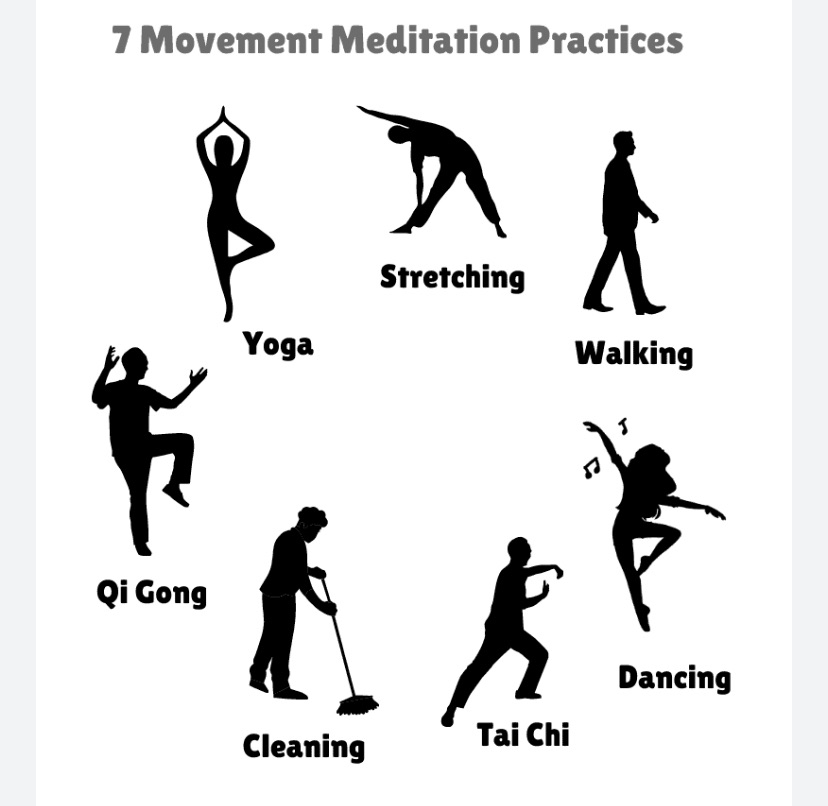
Movement meditations are something that we already know, they can be tai chi, yoga, even doing something therapeutic such as ironing, to cleaning the house. Meditation is just a name, meditation is actually what you make it. It is not the common ideal picture we have of sitting in an upright position, such as transcendence meditation, which I’ll go into later.
Transcendence, meditation, is the effortless meditation, which I actually do, which is effortless, and relaxed where you are not of the mind and of thoughts and completely immersed in your body and the present moment. This type of meditation is not for everyone. Some people may have an active mind, or have anxiety, or for many reasons, have an active mind which makes it difficult to do transcendence meditation. But that’s okay, because you have movement meditation.
Walking meditation, is one of them, It’s, where you are grounded in that present moment without talking, and just taking in the scenery, or the forest, or the park, this is still a meditation, this is enabling you to be mindful.
Some people ask how can walking be a meditation, as mentioned before meditation is a category, it is a word, but meditation can come in many different forms, and the good thing about it is that there are meditations for everyone.
The other forms of moving meditations, are tai chi, yoga, and that therapeutic ironing that we love to do, well for some of us. Qi Gong, is one of them also dancing, whatever brings you into that present moment whether you’re being mindful, or it takes your thinking away is still a meditation. Therefore, depending on what is needed for you at that present moment in your life, will determine what meditation is needed. As mentioned before, if the mind is active, that’s okay movement meditation is also there as a tool for you.
Depending on what movement meditation you are doing and if you want to go into a more still, relaxed meditation, movement meditation could be the prerequisite or the foundation to going into a deeper level of meditation. so you could start off with movement meditation, which is more active, and then maybe using music as a meditation as there are various forms of music that can take you into different states and then finally this could lead into the transcendence meditation, which is just you and your being.
So you could do mindful meditation, which helps you be more present, and bring your thoughts into this moment, and into what’s actually happening in your body and life, or you could use meditation for concentration to help you feel less distracted, you could use guided meditation to help assist you in your meditation, as well as using observation meditation to take you outside of yourself and concentrate and observe your thoughts and feelings in that way.
Movement meditation, overall is a great start to lead you onto any other meditation, depending on what you need, but just using movement meditation is enough to help you
My creativity didn’t start until my early 20s, the art that really made a significant impact in my life which is Music.
My mum had a stack of records which I would play for hours on end, and also then we had the cassette tapes which broke every two minutes, but you had the patience to put it back together because you couldn’t live without Music.
Music gave breath and substance to life, it told stories, processed emotions, and painted pictures, entertained and gave hope and deeper understanding about human relationships. Furthermore, when we started going to clubs as a teenager, I really saw how powerful Music was.
If you think about it, music brings communities, and people together, other than the other arts, such as drama, but Music is monumental, not saying it’s more important. It’s just more contagious and prevalent in our every day lives compared to the other arts. Luckily, I was fortunate to meet very musical people and run a Music publishing business for 10 years before I got into health and well-being as a career.
But in this blog I wanted to explain how music helped me create. I built my own Studio and Music was the foundation and sole significant reason why my healing was easier to go through as a young person.
I was going through a lot mentally and emotionally at that time, and Music was not only my way out. It was my way in. It did so much more than I can explain, and anyone that is moved by the arts, will understand this,
So from saying that, now I have established Soundwell which is a music and wellness platform, which is online that helps people to tap into their creative side, even if they have no previous experience. It’s not just for those that want to use music to aid wellbeing , but for those that just want to have fun, cause that’s what music is as well. It’s pleasing to hear it’s entertaining it’s exciting it’s moving it brings people together, but most of all it’s supportive and loving its courage. It brings wisdom, peace and happiness. It does so much things.
Another reason is that if you haven’t tapped into the creative side, music is one way where you can start, but if you feel the other arts are interesting please do explore and try. Even if it’s for once a week, once you get into the zone its the best feeling ever.
Emotional fitness is a fairly new term within the world of health and well-being. What it actually means is to be able to maintain, resolve, sustain and consistently find strength, when faced with challenges, stress, worry, and so forth.
The word is very similar to emotional wellness, emotional wellness again means the same thing, and also just being in a place, and having the skills to be resilient, on top of things, and knowing where to take yourself from one difficult situation to a place of resetting your nervous system and your logical mind and emotional body.
It is good to highlight, like any other person there are times when we don’t handle things well, we do become stressed or overwhelmed and that’s okay that’s all a part of life, but as you practice and observe yourself through the situations and circumstances you start to become more aware and you find, a map a inner map or compass to take you through the distressful events, whether that will be at work or in your personal life. It’s okay to not be okay though, sometimes we don’t have it all together and we’re not perfect. .
My emotional fitness levels are not the same as they were 20 years ago, and I’ve had significantly great people in my life that have guided me and provided sound mentorship to get to the place I am at today, I have gone back and forth throughout the years too. However, overall I’ve enjoyed the growth in the process. This is an important part to mention that to get to a level of emotional fitness, you have to enjoy self growth and self preservation in a sense, because that perspective will get you through the darkest times.
In the beginning, it may be difficult to sustain or remember, or utilise the information provided to yourself, or when you’re getting to know yourself and that can be difficult. However, finding what works uniquely for you is very helpful, knowing what you’re not as opposed to what you want to be, so that means understanding your capabilities, knowing your sensitivity levels, are key aspects of having a practical and productive level of skills in your life. When you are going through particular challenges in life, your mind, sometimes wants to already be at that place of peace and calm or in control which will then force you to want to speed up which would then create extra stress. Therefore, in this period what you ideally want to do is remember to take things slow and take things a day at a time, and really slow down the process, and again, this is one of the most difficult things to do, but it’s just something to be mindful of. This skill is having control of the thoughts and not the thoughts or feelings having control of you, basically not being too attached to the identity of the thoughts and feelings enough to observe them and then alter them.
So, whenever you are in a situation or circumstance, where you find yourself stressed, worried, unable to cope, it’s just being conscious, and mindful of how you are going to respond to the situation, and you don’t always get it right and sometimes you might have a laugh and think gosh, I didn’t do well this time, but that’s okay, that’s all part of developing and acquiring emotional fitness. To be honest it could take years to get to a level where you’re happy with your emotional fitness, wellness levels, I would never say it’s a speedy process but as the old saying goes it’s a journey not a destination and I know especially when something is painful or unpleasant you want things just to be okay and want to be in a better place which is natural.
We all have a certain limit of stress that we can handle, especially if there are two or three situations or circumstances that are happening at one time. Maybe its unresolved stresses from the past or triggers that affect us.
Whatever stresses us, the first thing we need to do is learn our nervous system, how that functions what affects us from the past, present and future and working day by day with ourselves and understanding how we react in the world. When dealing with different stresses, it is key to test ourselves within these circumstances, being able to observe how we are feeling and reacting and responding. There are two sides to this. Sometimes it’s us blaming the outside experience, or it could be the case of us not mastering our own internal emotional world. Knowing which one it is, is up to us and it’s something that we can learn as we grow and mature.
You may read things about taking responsibility for every situation, however, I disagree, not everything falls on yourself, sometimes we need boundaries, we need respect, we need others to also take accountability for their actions, especially if it’s projection of oneself and their own emotional experiences. Indeed, we can get to a place where we understand, and master others around us, but that doesn’t mean that we should be taken for granted.
Equanimity is a state of being, calm, serene mind within the face of adversity, stress, chaos, and difficulties. I first came across this state of being when studying Buddhism. As I was dealing with anger as a young person within my 20s and early 30s, the state of Equanimity helped me immensely. It’s also called the act of non-self interference. Again, it’s not to be mistaken for apathy, meaning, no emotion, numb, not feeling things or being responsive.
It means to be able to manage your emotions in a good way, without self sabotaging and creating extra friction and conflict within yourself, when it comes to difficult experiences and people. It’s a practice that some people have innately or it can be learned over time. Enabling you to manage or deal with problems more effectively.
The beginning practice is to observe yourself throughout every interaction and conversation with others and yourself. How are you responding? Not judging yourself, it should be like this and that, that’s interfering. What you want to do is get to a state where you are neither for or against it. Letting it not take over you but moving towards it. This is not to be rushed it is to be tested and used until it flows through you naturally. It then becomes a new you. A new perspective, a new alternative, a new approach, a healthy relationship with yourself and the outside world in deep concentration but non attachment to.







 benucation.com